
Everyone knows that websites are increasingly important for business. Many have even heard of SEO (search engine optimization). But fewer know about the difference between traditional SEO and local SEO. Let’s take a brief look how you can determine what the right kind of SEO is for your business.
Local SEO vs Traditional SEO
Local SEO is, as its name suggests, focused on ranking for local searches, whereas traditional SEO is about ranking for particular searches nationally or internationally.
Forty-six percent of all Google searches have a local intent. This generally means that the searcher is looking for something nearby. (It’s also worth noting how powerful it is – 80% of local searches on mobile convert!)
Let’s say, for example, you own a shoe shop. If you want most of your customers to be people in the area who visit your store, then you should optimize your website for local SEO.
This means you want your website to ‘rank’ (place highly on Google’s search results) for people nearby searching terms like ‘shoe shop near me’, ‘buy shoes in [your town/area]’, etc.
If, however, your main focus is actually on selling high volumes of shoes to people across the country (or world!), your main focus should be on traditional SEO. This means you want to rank highly for terms likely to be searched by people looking to buy shoes on online, such as ‘buy [shoe name] shoes online’, ‘best black work shoes’, etc.
The Best of Both Worlds
Of course, if you want both more people coming to your store and to sell more shoes online, then both kinds of SEO will be important for you.
Generally speaking, if you offer a relatively small-scale service, or sell perishable products (food, coffee, etc.) from a physical store, then local SEO is usually what you should focus on. After all, if you’re a small catering firm, ranking number one across the entire UK is going to mean a lot of travel and too much work to handle!
However, this does raise another point: your current or future plans. You have started outworking locally, but now want to expand and go national (or even global), in which case focusing first on local SEO and then on traditional SEO would obviously have been your path.
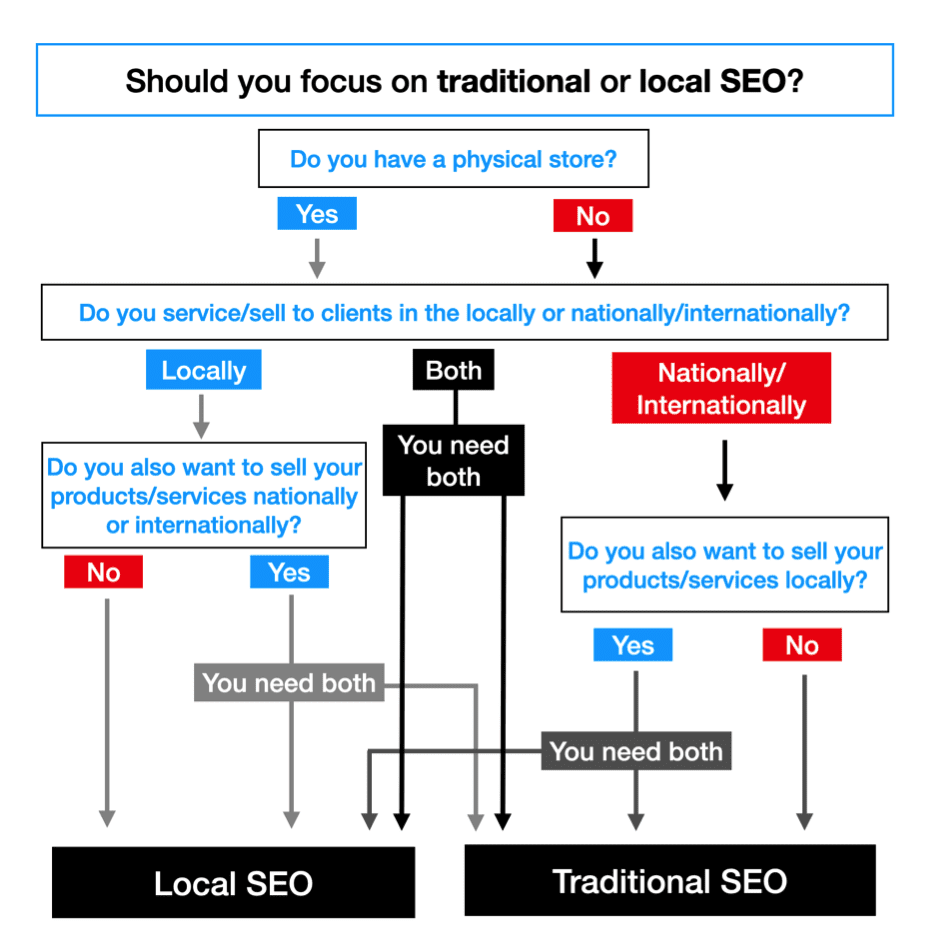
Each business has to decide for themselves where they want to gain more customers from. In the meantime, here is a simple chart to help out those who are undecided.
Overlap and Differences: An Example – Backlinks
There is a lot of overlap between local and traditional SEO. For example, keyword research and implementation, a well-designed website, and backlinks are important for both types of SEOBut there are also some fundamental differences within each of these categories.For example, having local backlinks is important for local SEO. But for traditional SEO, links more specific to your field or industry are what’s important.
What are backlinks? Backlinks are simply links from one site to another. For example, if my local newspaper website mentions your business and includes a link to your website in that mention, then you have just earned a backlink.
Having a lot of backlinks generally tells Google that your website is good (and therefore earns it a higher ranking) – however, the quality of the backlinks (i.e., how good the website they came from) is more important than the quantity.
For example, if you have a clothes shop looking to attract local clientele, it’s important to gain backlinks from other nearby businesses. This could mean local barbers, restaurants, plumbers, etc. The kind of business isn’t that important, the fact that they are in the same local area is.
Conversely, if you feel that locale clientele are not your priority (perhaps you sell high-end or niche clothes) then traditional SEO should be your priority. This means that gaining backlinks from leading luxury brand news sites, fashion bloggers, etc., are what you should seek.
Google My Business – An Indispensable Tool for Local SEO
Google My Business is a free tool provided by Google for businesses to list their contact details, location, updates, and more. The information in it comes up in the ‘Google 3-pack’ of information that appears in the map, above normal search results, when people make local searches.
In fact, even if you haven’t set up an account with Google My Business, there may already be one for your business – an astonishing 56% of businesses have not claimed their Google profile! So if your business is in any way concerned with local SEO, this should be your first step.
Why Both Kinds of SEO Are Important for Local SEO
Having said all of this, it is worth noting that focusing on both kinds of SEO is important for local SEO. This is important for two reasons.
Firstly, having your local website listed in the 3-pack results offers users a useful touchpoint when deciding whether to choose from you or your competitors (generally speaking, a website with good SEO is usually a good website!).
Secondly, 40% local searches venture past the ‘3-pack’ results’ and look at the websites listed below. You are throwing away a lot of potential customers if you aren’t there!
Conclusion
So the question faced by most businesses is not really whether to choose between local SEO or traditional SEO. The real question is whether to choose between local and traditional SEO or just traditional SEO. Once you have decided which path to take, you can get busy backlink hunting!