Street Walking: Brand Mascots

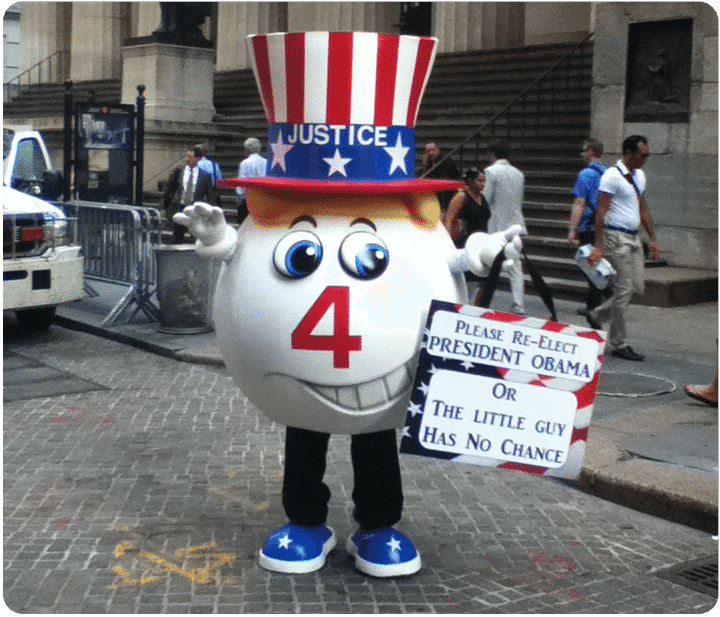
The 2012 Presidential election may be over a year away, but some Obama supporters are already showing their support. Regardless of your political leanings, though, the use of a Mr. Met-like costume could be a good way to get the attention of otherwise preoccupied New Yorkers.

Of course, brand mascots aren’t new. The Pillsbury Doughboy, California Raisins, Stay Puft Marshmallow Man (he got his fame in Ghostbusters, but is a brand mascot, nonetheless) and Ronald McDonald are a few who hit it big. You can see more brand mascots here.

Do you think your brand could benefit from a street character or mascot?
Submit a Street Walking Photo

If you have a marketing example you saw on the street that you’d like us to include in a future post, you can submit your photo here.


Picture of Chaz Michaels

Chaz Michaels

TRENDING AROUND THE WEB

Many adult children remember watching a father work sixty-hour weeks for decades so the family could have what he never did, then watched him die in his sixties without ever prioritizing his own happiness, and now see that same pattern quietly repeating in their own lives, under a different name.

Many adult children remember watching a father work sixty-hour weeks for decades so the family could have what he never did, then watched him die in his sixties without ever prioritizing his own happiness, and now see that same pattern quietly repeating in their own lives, under a different name.

Global English Editing

Eye tracking research on how people actually read web pages found that most visitors scan in a rough F shaped pattern down the left side of the screen, which is why professional editors front load the real information instead of slowly building up to it

Eye tracking research on how people actually read web pages found that most visitors scan in a rough F shaped pattern down the left side of the screen, which is why professional editors front load the real information instead of slowly building up to it

The Blog Herald

Harvard researchers had 166 undergraduates rate their own pets on qualities like thoughtful, considerate and sympathetic, and the students who felt most chronically disconnected from other people scored their pets meaningfully higher on exactly those three traits, and no others.

Harvard researchers had 166 undergraduates rate their own pets on qualities like thoughtful, considerate and sympathetic, and the students who felt most chronically disconnected from other people scored their pets meaningfully higher on exactly those three traits, and no others.

Global English Editing

A large-scale field study using real-world healthcare data found no measurable evidence that medical professionals make worse decisions as their workday wears on, directly contradicting one of the most frequently repeated claims in modern popular psychology writing

A large-scale field study using real-world healthcare data found no measurable evidence that medical professionals make worse decisions as their workday wears on, directly contradicting one of the most frequently repeated claims in modern popular psychology writing

The Blog Herald

University of Arizona researchers wired 79 people with a recorder sampling conversations every 12.5 minutes for four days and found the happiest had twice as many substantive conversations and a third as much small talk as the unhappiest, suggesting the discomfort was never a social deficit.

University of Arizona researchers wired 79 people with a recorder sampling conversations every 12.5 minutes for four days and found the happiest had twice as many substantive conversations and a third as much small talk as the unhappiest, suggesting the discomfort was never a social deficit.

Global English Editing

A landmark study found that Catholic nuns who wrote sparse, simple autobiographies in their early twenties, when they entered the convent in the 1930s, were far more likely to develop Alzheimer’s disease roughly six decades later, with about 80 percent of the low-complexity writers eventually developing the disease compared to only 10 percent of those whose youthful essays were dense with ideas

A landmark study found that Catholic nuns who wrote sparse, simple autobiographies in their early twenties, when they entered the convent in the 1930s, were far more likely to develop Alzheimer’s disease roughly six decades later, with about 80 percent of the low-complexity writers eventually developing the disease compared to only 10 percent of those whose youthful essays were dense with ideas

Global English Editing

Subscribe to receive our latest articles!

Get updates on the latest posts and more from Small Business Bonfire straight to your inbox.