
How to Add an Admin to Your Facebook Page

By Princess Jones

If one of your resolutions this year was to get a better handle on your business’ social media, you’re in good company. Research shows that as much 80 percent of small business owners wish they were better at social media. Many of them share the load with other people — employees, consultants, etc.

But adding another Facebook page admin isn’t much different than handing them the keys to your store. Fortunately, Facebook has made page roles more nuanced so that you can determine how much power a new user has with your brand page.

Facebook Page Roles

There are five types of page roles you can assign with varying roles, each with it’s own permissions:

  1. Analyst: Can view insights and see which of the other page roles published what content.
  2. Advertiser: Can do everything the Analyst can do and also create ads.
  3. Moderator: Can do everything the Analyst and the Advertiser can do and also send messages, delete comments and posts, and remove/ban people from the page.
  4. Editor: Can do everything the Analyst, the Advertiser, and the Moderator can do. Can also create and delete posts as the page as well as edit the page.
  5. Admin: Can do everything the others can do but also manage page roles and settings.
 

Adding a Page Role

Start by logging into your Facebook account and navigating to the brand page you’d like to make the changes on. Click “Settings” on the top right side of the page. Then, click “Page Roles” on the left side of the page dashboard.
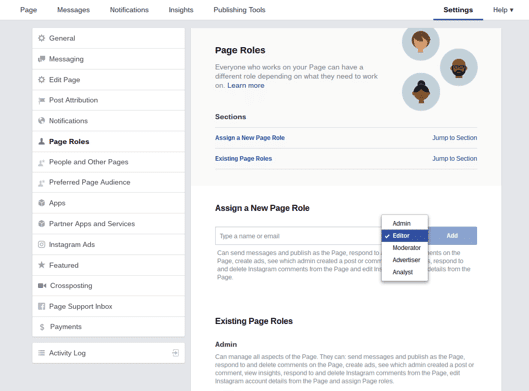
add facebook page admin

Under Assign a New Page Role, enter the name of the person you’d like to add. Next to it, toggle the role until it fits the one you’re looking for. (Note that the permissions you’ll be granting will appear in the box beneath it. You may want to double check it.) Click “Add” to complete the transaction. You’ll be prompted to enter your password again as confirmation.

An Admin can delete other Admins. So, it should go without saying that you shouldn’t add someone as an Admin who you do not know or who you do not trust. Someone could easily lock you out of your page and take it over. You’ll have to email Facebook and ask for arbitration in the issue. Avoid this by never adding anyone higher than an Editor to your page.

Editing and Deleting Page Role

If you want to edit the role for an already existing page role, you’ll scroll to the bottom of the page to the heading titled “Existing Page Roles.” The people will be grouped under similar roles — Admins together, Editors together, etc.

Click “Edit” next to the person you want to change. If you want to change their role, toggle on the right side of their name until you find the one you need. Then click “Save.”

If you’d like to remove them from your page, click “Remove.” You’ll get a pop-up asking you to confirm your decision. Click “Confirm” to finish.

You can learn more about page roles in the Facebook help section.

Picture of Chaz Michaels

Chaz Michaels

TRENDING AROUND THE WEB

Psychology says the single biggest predictor of whether adult children respect their parents isn’t how much was provided for them — it’s whether their parents respected them as separate people with valid perspectives, even when those perspectives conflicted

Psychology says the single biggest predictor of whether adult children respect their parents isn’t how much was provided for them — it’s whether their parents respected them as separate people with valid perspectives, even when those perspectives conflicted

Global English Editing

The people who navigate retirement with genuine contentment almost always went through a period that looked like depression from the outside but was actually the necessary dismantling of an identity that had outlived its usefulness

The people who navigate retirement with genuine contentment almost always went through a period that looked like depression from the outside but was actually the necessary dismantling of an identity that had outlived its usefulness

Global English Editing

Every time I look at my dog I feel this wave of sadness I can’t explain to anyone — not grief exactly, but something closer to the awareness that this pure, uncomplicated love has an expiration date I’m not ready for

Every time I look at my dog I feel this wave of sadness I can’t explain to anyone — not grief exactly, but something closer to the awareness that this pure, uncomplicated love has an expiration date I’m not ready for

Global English Editing

I’ve been waking up at 5:30 a.m. for three years straight and the hardest part isn’t the discipline – it’s realizing that the quiet hour before anyone needs me is the only time I actually recognize myself

I’ve been waking up at 5:30 a.m. for three years straight and the hardest part isn’t the discipline – it’s realizing that the quiet hour before anyone needs me is the only time I actually recognize myself

Global English Editing

I grew up in the 1970s when nobody asked how I was feeling and honestly, I think that’s why I can sit with discomfort in a way my own kids never learned — because I was never taught that every uncomfortable moment required immediate intervention

I grew up in the 1970s when nobody asked how I was feeling and honestly, I think that’s why I can sit with discomfort in a way my own kids never learned — because I was never taught that every uncomfortable moment required immediate intervention

Global English Editing

I’m 73 and I watched my grandson have a panic attack over a delayed package — and I realized the gap between how I was raised and how he was raised isn’t just generational, it’s a completely different operating system for handling adversity

I’m 73 and I watched my grandson have a panic attack over a delayed package — and I realized the gap between how I was raised and how he was raised isn’t just generational, it’s a completely different operating system for handling adversity

Global English Editing

Subscribe to receive our latest articles!

Get updates on the latest posts and more from Small Business Bonfire straight to your inbox.





